Monday, October 09, 2006
Current REVIEWS on-site
Current reviews on-site are: the BBC's Jane Eyre, Episodes 1, 2 and now 3; BBC1's Robin Hood; Children of Men, The Departed - and soon to follow, Wide Sargasso Sea.


Children of Men, a grimly beautiful cinematic feast (spoilers) REVIEW
REVIEW: CHILDREN OF MEN, PD JAMES, 2006
I finally caught up with Alfonso Cuaron's Children of Men this weekend, a film based on the dark and chilling PD James novel. In short, the plot focuses on a tragically apocalyptic world set in 2027, a world dogged by a fertility crisis which has meant there has not been a new baby born at all, in over eighteen years. Wars have ravaged the planet, the environment is in a funk from decades of prolonged pollution and mankind is in freefall, offered suicide packs by the government which promise a quiet and painless demise. A totalitarian British government herds all foreigners ('fugees) into concentration camps and multiple terrorist groups seemingly stage bombings for fun. And yet, miraculously, amidst this angst and mayhem, a young woman, Kee, has fallen pregnant and seeks safety with the much-fabled 'Human Project' - a quasi-mythical settlement on the Azores, far away from the grime and misery of mainland Britain. The story charts Kee's desperate attempt to escape to a new life, accompanied by her protector Theo, one of fiction's unsuspecting heroes - a man who suddenly finds himself at the crossroads of history and rises to the occasion.
I should say for starters that I am a huge fan of Cuaron's work. He directed, in my opinion, the best Harry Potter film so far - by a country mile I might add. His work on Great Expectations and A Little Princess was eye-catching. And Y Tu Mama Tambien was one of my favourite films of 2001. He does not disappoint with Children of Men. Cuaron has an astonishing feel for the cinematic medium. Every single frame is crammed with visual delights. More than most directors he succinctly moves and moulds narrative with cinematographic brilliance and has a talent for deploying colour, or lack of it, when necessary. He genuinely paints a story for us with a magically illustrative visual vocabulary.
Here we are presented with a dank, rain-strewn world; a bleak, grey landscape, scarred by numerous power-stations belching thick smoke. The city streets are dirty, clostraphobic and crowded and buildings are graffiti-ed and fallen into disrepair. After all, what is the point of rebuilding a world which no-one soon will be able to enjoy? The only 'renewed' spot is the slightly surreal Ministry of Art, housed in Battersea Power Station, its interiors a spartan, gleaming white adorned by world-famous works of art such as Picasso's Guernica (very fitting) and Michelangelo's David, which have been 'rescued'. Here Theo meets his cousin, a government minister who claims to cope by not thinking about anything - but sure enough, we spot a huge, dummy pig wafting past the window.
The single point of pleasant respite in the entire film is the home of Theo's long-time friend and mentor, Jasper. His hidden settlement in the forest is a warm, friendly place, full of comfy furnishings, plants, music and animals. Indeed, young animals pervade this film - kittens and puppies galore - a sharp reminder that it is only mankind who has failed, who has shown incapable of surviving.
In addition to his aesthetic talents, Cuaron is also good at eliciting strong acting performances and here he fares well too, although perhaps not quite so well as former films. Having said that, Michael Caine is simply fantastic as genial hippy Jasper - a real scene-stealer. As indeed is Peter Mullan, an unsung hero of British filmmaking, who takes on the minor rumbustious role of Sid, the corrupt border official. Claire Hope-Ashitey is fine as Kee, the first woman in eighteen years to give birth, (her name is a little too heavyhanded symbolically), and Pam Ferris as her anxious guardian Miriam is passable, but this is not her best work by any means. Julianne Moore is one of Hollywood's greatest actresses but is really rather ordinary here - although her early death is shocking and raw. Chiwetel Ejiofor is always good value but a little under-used here as the idealistic Luke.
Clive Owen puts in a brave performance as Theo, the sourfaced, cynical everyman, who takes it upon himself to escort poor Kee to the sanctity of a ship headed for The Human Project. To do so requires a perilous journey, avoiding terrorists who wish to exploit Kee's baby for their own propaganda purposes, avoiding murderous thug-like British police officers, representatives of the State who would also exploit Kee's baby for their own propaganda purposes, or so Theo and Kee are warned - although Theo is dubious.
Their journey takes them to 'Bexhill' - a town turned notorious refugee camp, enmired in filth and despair, where a minor civil uprising is being quashed most violently by the authorities. The epiphany of the piece is when Theo helps deliver Kee's baby girl in a squalid room in this camp. Obviously it is hard to ignore the 'messianic' theme in play here, and this is further emphasised later when Theo, Kee and child escape from a bombarded block of flats, where miserable refugees are cowering in fear from the bomb blasts and gunfire which continuously rock the building. Kee's baby starts crying, a thin, reedy but unmistakable cry amidst the thunderous furore of warfare raging around them. Suddenly everyone stops. Many fall to their knees in prayer. Many try to touch the baby and her mother. Even the armoured police and militia hold fire, if only for a few moments, to gaze in wonder at this newborn life - only to resume their bloodthirsty battle seconds later ...
Of course there are blood-sacrifices. We know they're coming. But that doesn't make them any less powerful. Jasper resigns himself to a cruel death at the hand of the terrorists who are dead set on securing Kee and her child for their own political purposes - but in doing so, Jasper enables Theo, Kee and Miriam temporary respite and an escape. There are other surprising acts of heroism on the way. Marichka, played by Oana Pellea, is at first sight, a repulsive, grasping woman in the refugee camp, who frightens Kee. But this woman does all she can to save the mother and her child, and is finally resigned we fear to a certain death in the refugee camp as Theo and Kee spot fighter planes raining bombs down on Bexhill in the closing sequences. And then, of course, there is Theo. You know it will happen. It's how these types of narratives always work; but you still wish it didn't have to end this way.
There is alot to love in this film - and a lot to worry over. Most affecting for me was the news that Theo and Julian had lost their young child in 2008 to a flu pandemic - a death that clearly haunted and destroyed their relationship - though probably not their love. There is a very moving moment when Jasper recounts the sorry story of their loss to Kee and Miriam - not knowing that Theo is in earshot. The camera slowly closes in on Theo's face which is stricken at the memory. Saving Kee and her child thus gives him a second chance to save a child when he could not save his own.
I finally caught up with Alfonso Cuaron's Children of Men this weekend, a film based on the dark and chilling PD James novel. In short, the plot focuses on a tragically apocalyptic world set in 2027, a world dogged by a fertility crisis which has meant there has not been a new baby born at all, in over eighteen years. Wars have ravaged the planet, the environment is in a funk from decades of prolonged pollution and mankind is in freefall, offered suicide packs by the government which promise a quiet and painless demise. A totalitarian British government herds all foreigners ('fugees) into concentration camps and multiple terrorist groups seemingly stage bombings for fun. And yet, miraculously, amidst this angst and mayhem, a young woman, Kee, has fallen pregnant and seeks safety with the much-fabled 'Human Project' - a quasi-mythical settlement on the Azores, far away from the grime and misery of mainland Britain. The story charts Kee's desperate attempt to escape to a new life, accompanied by her protector Theo, one of fiction's unsuspecting heroes - a man who suddenly finds himself at the crossroads of history and rises to the occasion.
I should say for starters that I am a huge fan of Cuaron's work. He directed, in my opinion, the best Harry Potter film so far - by a country mile I might add. His work on Great Expectations and A Little Princess was eye-catching. And Y Tu Mama Tambien was one of my favourite films of 2001. He does not disappoint with Children of Men. Cuaron has an astonishing feel for the cinematic medium. Every single frame is crammed with visual delights. More than most directors he succinctly moves and moulds narrative with cinematographic brilliance and has a talent for deploying colour, or lack of it, when necessary. He genuinely paints a story for us with a magically illustrative visual vocabulary.
Here we are presented with a dank, rain-strewn world; a bleak, grey landscape, scarred by numerous power-stations belching thick smoke. The city streets are dirty, clostraphobic and crowded and buildings are graffiti-ed and fallen into disrepair. After all, what is the point of rebuilding a world which no-one soon will be able to enjoy? The only 'renewed' spot is the slightly surreal Ministry of Art, housed in Battersea Power Station, its interiors a spartan, gleaming white adorned by world-famous works of art such as Picasso's Guernica (very fitting) and Michelangelo's David, which have been 'rescued'. Here Theo meets his cousin, a government minister who claims to cope by not thinking about anything - but sure enough, we spot a huge, dummy pig wafting past the window.
The single point of pleasant respite in the entire film is the home of Theo's long-time friend and mentor, Jasper. His hidden settlement in the forest is a warm, friendly place, full of comfy furnishings, plants, music and animals. Indeed, young animals pervade this film - kittens and puppies galore - a sharp reminder that it is only mankind who has failed, who has shown incapable of surviving.
In addition to his aesthetic talents, Cuaron is also good at eliciting strong acting performances and here he fares well too, although perhaps not quite so well as former films. Having said that, Michael Caine is simply fantastic as genial hippy Jasper - a real scene-stealer. As indeed is Peter Mullan, an unsung hero of British filmmaking, who takes on the minor rumbustious role of Sid, the corrupt border official. Claire Hope-Ashitey is fine as Kee, the first woman in eighteen years to give birth, (her name is a little too heavyhanded symbolically), and Pam Ferris as her anxious guardian Miriam is passable, but this is not her best work by any means. Julianne Moore is one of Hollywood's greatest actresses but is really rather ordinary here - although her early death is shocking and raw. Chiwetel Ejiofor is always good value but a little under-used here as the idealistic Luke.
Clive Owen puts in a brave performance as Theo, the sourfaced, cynical everyman, who takes it upon himself to escort poor Kee to the sanctity of a ship headed for The Human Project. To do so requires a perilous journey, avoiding terrorists who wish to exploit Kee's baby for their own propaganda purposes, avoiding murderous thug-like British police officers, representatives of the State who would also exploit Kee's baby for their own propaganda purposes, or so Theo and Kee are warned - although Theo is dubious.
Their journey takes them to 'Bexhill' - a town turned notorious refugee camp, enmired in filth and despair, where a minor civil uprising is being quashed most violently by the authorities. The epiphany of the piece is when Theo helps deliver Kee's baby girl in a squalid room in this camp. Obviously it is hard to ignore the 'messianic' theme in play here, and this is further emphasised later when Theo, Kee and child escape from a bombarded block of flats, where miserable refugees are cowering in fear from the bomb blasts and gunfire which continuously rock the building. Kee's baby starts crying, a thin, reedy but unmistakable cry amidst the thunderous furore of warfare raging around them. Suddenly everyone stops. Many fall to their knees in prayer. Many try to touch the baby and her mother. Even the armoured police and militia hold fire, if only for a few moments, to gaze in wonder at this newborn life - only to resume their bloodthirsty battle seconds later ...
Of course there are blood-sacrifices. We know they're coming. But that doesn't make them any less powerful. Jasper resigns himself to a cruel death at the hand of the terrorists who are dead set on securing Kee and her child for their own political purposes - but in doing so, Jasper enables Theo, Kee and Miriam temporary respite and an escape. There are other surprising acts of heroism on the way. Marichka, played by Oana Pellea, is at first sight, a repulsive, grasping woman in the refugee camp, who frightens Kee. But this woman does all she can to save the mother and her child, and is finally resigned we fear to a certain death in the refugee camp as Theo and Kee spot fighter planes raining bombs down on Bexhill in the closing sequences. And then, of course, there is Theo. You know it will happen. It's how these types of narratives always work; but you still wish it didn't have to end this way.
There is alot to love in this film - and a lot to worry over. Most affecting for me was the news that Theo and Julian had lost their young child in 2008 to a flu pandemic - a death that clearly haunted and destroyed their relationship - though probably not their love. There is a very moving moment when Jasper recounts the sorry story of their loss to Kee and Miriam - not knowing that Theo is in earshot. The camera slowly closes in on Theo's face which is stricken at the memory. Saving Kee and her child thus gives him a second chance to save a child when he could not save his own.
BBC Jane Eyre - Episode 3 (REVIEW)
REVIEW: JANE EYRE 3/4, CHARLOTTE BRONTE, BBC 1, 2005
And so to the third (and penultimate) episode of the BBC's period adaptation of Jane Eyre ... and what a pleasing episode it was. Susanna White's direction seems to have gained in zing, zip and imagination as the series has progressed and we had some lovely visual sequences to feast our eyes on this time round. Most exotic of all were flashback references to Rochester's time in the Caribbean and his love affair with Bertha, evoked by a delightfully dreamy cacophony of vibrant colours, and of course, her own sensual beauty.
'Flashback' was in vogue this episode as Jane made her own foray into her sad childhood when she was forced to return to Gateshead, host to her misery at the hands of the callous Reed family. As Jane enters the house she is haunted by the sounds of her cruel childhood experiences. We learn that John Reed, her primary torturer as a child, is dead and gone, but thankfully we are left with Georgiana and Eliza, his two ill-natured sisters who constantly snap and snarl at each other in splendidly catty fashion. Tara Fitzgerald as wicked Aunt Reed gets to chew the scenery in an extensive dying scene, although as a sure sign of my own innate shallowness, I couldn't help but admire the marvellously detailed painted wallpaper in her bedchamber while her death-throes were in full throttle.
However, this particular Jane Eyre being very much a two-handed affair, while Jane is away we also still have scenes set at Thornfield with Rochester and the Ingram House Party - primarily to demonstrate how Rochester has split off from his guests to mope over Jane's absence. At one stage he confronts Blanche to ask her what she 'really' wants, but we never get to hear exactly what that it is, nor can we really hazard a guess from her rather blank but pretty features.
On Jane's return we meet Mr Eshton again, off to investigate twins who can mentally communicate even when many miles apart - Jane and Rochester are almost frothing over with glee at being reunited, and the reference is all too clear that THEY too share such a bond. This is made clearer still as the lovesick duo discuss the possibility of parting pending his marriage, which is such a shame, as Jane makes such a big deal of settling in so nicely to Thornfield on her return, even telling Rochester when they first meet up again that her home is wherever HE is - a bit of a 'whoah steady on there' moment, until you remember this IS Jane Eyre after all, one of the greatest love stories in British literary history - so no need to panic. Her love WILL be requited.
A nice touch to their budding romance is Rochester's genuine interest in Jane's past - 'the deep, dark forests' of her childhood memories as he calls it. There is a very real sense of mutual intellectual engagement enacted pleasingly by Toby Stephens and Ruth Wilson - the latter barely able to wipe the loved-up smile off her face when she is in his presence. Of course Rochester cannot be so innocently joyous as we are reminded of his vivid past when he recounts his time in the Caribbean, describing it as seductive, mysterious, tantalising, dangerous - and again we see a profusion of scarlets, crimsons, pinks in flashback to his time there, red signifying Bertha in this production - and then his eyes flit anxiously to the dark tower where we (well, most of us probably by now) know she is imprisoned.
The sense that Bertha is watching events below is stepped up in this episode - we are aware of a figure watching through a window, accompanied by soft tinkling bells and lush but eery music. While the idea is a tad hackneyed, it is actually well-executed here to slightly chilling, even poignant effect. Particularly useful is the musical scoring which works extremely well in this episode - unlike the first two episodes I have to say. It's as though Rob Lane, the composer, really let rip with the romantic vibe, and it truly suits this section of the story.
At the half-way point through this hour-long episode we finally arrive at the lovelorn couple's eventual ardent declaration, preceded by what I consider to the most glorious passage in the entire novel, rendered well here by Ruth Wilson, when Jane floods forth with her feelings to an awed and moved Rochester. This is one of the most exciting and proto-feminist speeches in nineteenth century English literature - indeed, any literature, of any time - when Jane confronts Rochester with her desire to be free, to love, as any man, in spite of her being 'poor, obscure, plain, and little' now switched to 'poor, plain, obscure and little' - but quibbles aside, much is sourced almost direct from the novel, where Jane speaks so powerfully. Here there are a few adjustments for modern sensiblities, so for example, Rochester bids her become his equal through marriage, which is now telegraphed in the TV version by Jane's praise of her treatment at Thornfield as an 'equal'.
I am not usually one for seeking close adherence to a source text's original wording, but in this single instance, Jane's impassioned declaration of Selfhood is so intensely felt and strongly expressed, it would be a shame to meddle too far. Of course one forgets just how radical and effecting this novel was in its day. Here we had a heroine who acknowledged her sensual yearnings, who wanted to work and construct her own life, her own identity, who is damning of the foibles, fripperies and minutiae which consumed most women's lives at the time, trapped into a world of passive domesticity.
Jane and Rochester's final declarations of mutual love are set here in a damp, sunny glade. Toby Stephens's voice suddenly goes a little gruff and sore-sounding when declaring his own feelings for her, which half made me wish I could chuck the poor fellow a throat lozenge. He squeezes her close to his manly chest, and they finally kiss, and then kiss again, and again, before they run hand in hand through one of those impromptu CGI-ed thunderstorms complete with a quavering bright bolt of lightening that you sometimes get in TV land.
Just to be a true curmudgeon - was anyone else a little unimpressed with the happy couple's kissing style? It seemed to comprise a momentary smashing together of face and cheek at regular intervals, all well and good, but I was sure they kept missing each other's lips, which is clearly the primary object of the exercise. I hate to do this, but in comparison to the one shot we get of Rochester snogging the face off Bertha, Jane and Rochester's physical union seemed a little more staid and demure, despite their obvious mutual enthusiasm.
According to the golden rules of TV and cinema, Jane's blossoming love affair must instill a new sense of self-worth which is belied by her flourishing good looks and lustrous femininity, hence we have a slightly annoying scene where Ruth Wilson flounces around her bedchamber, long locks flowing, as she gazes lovingly at herself in a mirror. In fact this mirror is a rather laboured device throughout the series so far, charting Jane's self-esteem with her outward appearance, which is a very easily translatable behaviour of course. Jane drops her habitual dark clothing and dons a very pale almost-white-grey gown, reflecting her brighter mood. This is then mirrored at the end of the episode, once her dream-world has been sadly punctured, and she silently slips out of her brilliant white wedding dress and re-dresses herself in the gloomy grey garb we have come to associate with melancholic, sensible Jane.
We have forbodings of course that the wedding will not go well; kindly Mrs Fairfax's concern and irritation, Jane's nightmare and the rather scary moment when she senses someone is in her room at night and then finds her wedding veil has been torn. There is something all too desperate about Rochester's determination to march her uphill to her wedding in a sadly deserted church, and the news of his first marriage, when it comes from Briggs and then Mason, is far from surprising - more miserable than dramatic.
The same can be said for our eventual meeting with Bertha. Jane spots the red scarf, Bertha's symbol during this series, flapping in the open window. The look on her face is more disappointed than shocked - almost as though, like us, deep-down she knew this would happen all along. There is an inevitability to this turn of events which is captured well by her still, sad, tear-stained face.
Toby Stephens doesn't play Rochester as strident or hysterical or even particularly angered at how his dirty secret has finally come to light. He has the deflated air of a man who has finally been defeated, by himself. He recounts his misadventures in the Caribbean and we briefly see in flashback how Bertha descended into lunacy, as signified (a little crudely and chauvinistically perhaps) by her rapacious sexual appetites - and, most disturbingly, by a maniacal scene with Rochester, which darkly hints at a violent sexuality within their own tormented relationship.
Throughout his account, there is a strange three-pronged mark, livid and red, on Rochester's neck - did Bertha bite him, as she did her brother? Or did Toby Stephens have a rather frenzied encounter with his Phillishave that morning, which they forgot to conceal with make-up? Either way, the marks are distracting and disconcerting - a vivid reminder of the physical pain that has clearly been enacted in his relations with his 'wife.' At one point Rochester explains that he could have checked Bertha in to 'another' house he owns, where she would likely have lived and died a damp and sickly existence. Of course the fact he chose to incarcerate her instead in his bleak and gloomy North Tower does not especially salvage the situation, and I for one, was partly glad when Jane refused to open her bedchamber door to hear his pleas for mercy and a life of 'sin' which would at that time have condemned Jane Eyre as a sluttish outsider for the rest of her days.
And finally, two sweetly poignant moments stand out. In the church, as soon as Briggs and Mason explain how Rochester met his first wife in Jamaica, there is a fleeting look of mournful understanding on Jane's face, as she clearly recalls Rochester's embittered speech on the dangerously seductive qualities of that part of the world. She knows right then, that what they are saying is all too true. And then again, when Jane and Rochester return to Thornfield from the church, they are greeted merrily by the servants of the house with Adele, who shower them with corn and confetti - a pathetic irony in the circumstances.
Reviews of Jane Eyre, Episodes 1 and 2 and 4. Also Wide Sargasso Sea.
And so to the third (and penultimate) episode of the BBC's period adaptation of Jane Eyre ... and what a pleasing episode it was. Susanna White's direction seems to have gained in zing, zip and imagination as the series has progressed and we had some lovely visual sequences to feast our eyes on this time round. Most exotic of all were flashback references to Rochester's time in the Caribbean and his love affair with Bertha, evoked by a delightfully dreamy cacophony of vibrant colours, and of course, her own sensual beauty.
'Flashback' was in vogue this episode as Jane made her own foray into her sad childhood when she was forced to return to Gateshead, host to her misery at the hands of the callous Reed family. As Jane enters the house she is haunted by the sounds of her cruel childhood experiences. We learn that John Reed, her primary torturer as a child, is dead and gone, but thankfully we are left with Georgiana and Eliza, his two ill-natured sisters who constantly snap and snarl at each other in splendidly catty fashion. Tara Fitzgerald as wicked Aunt Reed gets to chew the scenery in an extensive dying scene, although as a sure sign of my own innate shallowness, I couldn't help but admire the marvellously detailed painted wallpaper in her bedchamber while her death-throes were in full throttle.
However, this particular Jane Eyre being very much a two-handed affair, while Jane is away we also still have scenes set at Thornfield with Rochester and the Ingram House Party - primarily to demonstrate how Rochester has split off from his guests to mope over Jane's absence. At one stage he confronts Blanche to ask her what she 'really' wants, but we never get to hear exactly what that it is, nor can we really hazard a guess from her rather blank but pretty features.
On Jane's return we meet Mr Eshton again, off to investigate twins who can mentally communicate even when many miles apart - Jane and Rochester are almost frothing over with glee at being reunited, and the reference is all too clear that THEY too share such a bond. This is made clearer still as the lovesick duo discuss the possibility of parting pending his marriage, which is such a shame, as Jane makes such a big deal of settling in so nicely to Thornfield on her return, even telling Rochester when they first meet up again that her home is wherever HE is - a bit of a 'whoah steady on there' moment, until you remember this IS Jane Eyre after all, one of the greatest love stories in British literary history - so no need to panic. Her love WILL be requited.
A nice touch to their budding romance is Rochester's genuine interest in Jane's past - 'the deep, dark forests' of her childhood memories as he calls it. There is a very real sense of mutual intellectual engagement enacted pleasingly by Toby Stephens and Ruth Wilson - the latter barely able to wipe the loved-up smile off her face when she is in his presence. Of course Rochester cannot be so innocently joyous as we are reminded of his vivid past when he recounts his time in the Caribbean, describing it as seductive, mysterious, tantalising, dangerous - and again we see a profusion of scarlets, crimsons, pinks in flashback to his time there, red signifying Bertha in this production - and then his eyes flit anxiously to the dark tower where we (well, most of us probably by now) know she is imprisoned.
The sense that Bertha is watching events below is stepped up in this episode - we are aware of a figure watching through a window, accompanied by soft tinkling bells and lush but eery music. While the idea is a tad hackneyed, it is actually well-executed here to slightly chilling, even poignant effect. Particularly useful is the musical scoring which works extremely well in this episode - unlike the first two episodes I have to say. It's as though Rob Lane, the composer, really let rip with the romantic vibe, and it truly suits this section of the story.
At the half-way point through this hour-long episode we finally arrive at the lovelorn couple's eventual ardent declaration, preceded by what I consider to the most glorious passage in the entire novel, rendered well here by Ruth Wilson, when Jane floods forth with her feelings to an awed and moved Rochester. This is one of the most exciting and proto-feminist speeches in nineteenth century English literature - indeed, any literature, of any time - when Jane confronts Rochester with her desire to be free, to love, as any man, in spite of her being 'poor, obscure, plain, and little' now switched to 'poor, plain, obscure and little' - but quibbles aside, much is sourced almost direct from the novel, where Jane speaks so powerfully. Here there are a few adjustments for modern sensiblities, so for example, Rochester bids her become his equal through marriage, which is now telegraphed in the TV version by Jane's praise of her treatment at Thornfield as an 'equal'.
I am not usually one for seeking close adherence to a source text's original wording, but in this single instance, Jane's impassioned declaration of Selfhood is so intensely felt and strongly expressed, it would be a shame to meddle too far. Of course one forgets just how radical and effecting this novel was in its day. Here we had a heroine who acknowledged her sensual yearnings, who wanted to work and construct her own life, her own identity, who is damning of the foibles, fripperies and minutiae which consumed most women's lives at the time, trapped into a world of passive domesticity.
Jane and Rochester's final declarations of mutual love are set here in a damp, sunny glade. Toby Stephens's voice suddenly goes a little gruff and sore-sounding when declaring his own feelings for her, which half made me wish I could chuck the poor fellow a throat lozenge. He squeezes her close to his manly chest, and they finally kiss, and then kiss again, and again, before they run hand in hand through one of those impromptu CGI-ed thunderstorms complete with a quavering bright bolt of lightening that you sometimes get in TV land.
Just to be a true curmudgeon - was anyone else a little unimpressed with the happy couple's kissing style? It seemed to comprise a momentary smashing together of face and cheek at regular intervals, all well and good, but I was sure they kept missing each other's lips, which is clearly the primary object of the exercise. I hate to do this, but in comparison to the one shot we get of Rochester snogging the face off Bertha, Jane and Rochester's physical union seemed a little more staid and demure, despite their obvious mutual enthusiasm.
According to the golden rules of TV and cinema, Jane's blossoming love affair must instill a new sense of self-worth which is belied by her flourishing good looks and lustrous femininity, hence we have a slightly annoying scene where Ruth Wilson flounces around her bedchamber, long locks flowing, as she gazes lovingly at herself in a mirror. In fact this mirror is a rather laboured device throughout the series so far, charting Jane's self-esteem with her outward appearance, which is a very easily translatable behaviour of course. Jane drops her habitual dark clothing and dons a very pale almost-white-grey gown, reflecting her brighter mood. This is then mirrored at the end of the episode, once her dream-world has been sadly punctured, and she silently slips out of her brilliant white wedding dress and re-dresses herself in the gloomy grey garb we have come to associate with melancholic, sensible Jane.
We have forbodings of course that the wedding will not go well; kindly Mrs Fairfax's concern and irritation, Jane's nightmare and the rather scary moment when she senses someone is in her room at night and then finds her wedding veil has been torn. There is something all too desperate about Rochester's determination to march her uphill to her wedding in a sadly deserted church, and the news of his first marriage, when it comes from Briggs and then Mason, is far from surprising - more miserable than dramatic.
The same can be said for our eventual meeting with Bertha. Jane spots the red scarf, Bertha's symbol during this series, flapping in the open window. The look on her face is more disappointed than shocked - almost as though, like us, deep-down she knew this would happen all along. There is an inevitability to this turn of events which is captured well by her still, sad, tear-stained face.
Toby Stephens doesn't play Rochester as strident or hysterical or even particularly angered at how his dirty secret has finally come to light. He has the deflated air of a man who has finally been defeated, by himself. He recounts his misadventures in the Caribbean and we briefly see in flashback how Bertha descended into lunacy, as signified (a little crudely and chauvinistically perhaps) by her rapacious sexual appetites - and, most disturbingly, by a maniacal scene with Rochester, which darkly hints at a violent sexuality within their own tormented relationship.
Throughout his account, there is a strange three-pronged mark, livid and red, on Rochester's neck - did Bertha bite him, as she did her brother? Or did Toby Stephens have a rather frenzied encounter with his Phillishave that morning, which they forgot to conceal with make-up? Either way, the marks are distracting and disconcerting - a vivid reminder of the physical pain that has clearly been enacted in his relations with his 'wife.' At one point Rochester explains that he could have checked Bertha in to 'another' house he owns, where she would likely have lived and died a damp and sickly existence. Of course the fact he chose to incarcerate her instead in his bleak and gloomy North Tower does not especially salvage the situation, and I for one, was partly glad when Jane refused to open her bedchamber door to hear his pleas for mercy and a life of 'sin' which would at that time have condemned Jane Eyre as a sluttish outsider for the rest of her days.
And finally, two sweetly poignant moments stand out. In the church, as soon as Briggs and Mason explain how Rochester met his first wife in Jamaica, there is a fleeting look of mournful understanding on Jane's face, as she clearly recalls Rochester's embittered speech on the dangerously seductive qualities of that part of the world. She knows right then, that what they are saying is all too true. And then again, when Jane and Rochester return to Thornfield from the church, they are greeted merrily by the servants of the house with Adele, who shower them with corn and confetti - a pathetic irony in the circumstances.
Reviews of Jane Eyre, Episodes 1 and 2 and 4. Also Wide Sargasso Sea.
Sunday, October 08, 2006
Robin Hood not so merry (REVIEW)
REVIEW: ROBIN HOOD, BBC 1, 2006
Just a few thoughts on the BBC's new 13-part series of Robin Hood. This production, rumoured to cost £8m to make, has been scheduled in the family-friendly Saturday 7.00pm slot, effectively replacing Doctor Who - but I highly doubt this will prove to be anywhere near as popular. Pundits claims the SECOND episode is worth the wait; it had better be. This was very average I'm afraid.
First up, the sets are a rather shoddy affair. So, for example, medieval villages are clean, sanitised, neatly presented thatched cottages - no attempt at realist presentation or even a stab at fantasy genre instead.
Acting performances are middling at best. Jonas Armstrong as Robin of Locksley looks like he might grab a microphone and break into a Britpop ballad complete with Mancunian drawl at any given minute. Sam Troughton as cheeky chappie Much, Robin's best mate, is wearing thin already. His laddish banter during the opening scenes with Robin felt desperately contrived. At one point the Sheriff of Nottingham, played here with some panache thankfully by Keith Allen, tells Robin to say goodbye to his little friend 'Mulch' (Much is being dangled from castle ramparts by the Sheriff's soldiers). Robin retorts: 'His name’s Much', to which Allen quips, 'Well, he’ll be Mulch in the minute.' I was rather disappointed when this didn't actually come to pass. On current form he'd be little loss.
Maid Marion seemed a ballsy, lantern-jawed, won't-take-any-nonsense type of lass who even killed a fellow with a sharply-aimed hairpin of all things. So she could certainly prove a useful wee number in the battles we can be sure are soon to come and keep coming against the dastardly Sheriff and his henchman Guy of Gisborne, played rather uncomfortably by Richard Armitage. I didn't get much of a sense of the remaining cast as yet, although they have 12 episodes to flesh them out I guess.
I'm not certain I'll stay the course with this series beyond a few more episodes. It very much depends here on the old-fashioned art of storytelling. I did, however, like the usage of the Robin of Locksley myth, which was also deployed in the Kevin Costner Robin Hood: Prince of Thieves movie. Plus, there was certainly a fair deal of political mileage extracted from this plotline. Robin has returned from the Crusades with a strong distaste for War. In a heated exchange with the Sheriff, Robin claims that the war is 'not our war' but Pope Gregory's. The Sheriff says they stand 'shoulder to shoulder' with the crusaders ... a clearly deliberate echoing from screenwriter Dominic Minghella of the type of lingo used when discussing Britain's role in the Iraq War and Blair's 'shoulder to shoulder' attitude towards US warmongers. But it is clear that our populist hero wants no truck with such wars. While the analogy was pretty crudely effected, it was interesting that such a transparent comparative device could be utilised so easily.
On a slightly more trivial but peculiarly jarring note, my history books certainly never taught me that Max Factor was alive and kicking in the Middle Ages. But here we have both Maid Marion and a 'comely wench' who cadges a quick snog off Robin (thereby 'proving' to us dumb audiences, that despite his not-so-obvious attractions, this chap is dead sexy), literally caked in make-up complete with super-gloss lipsticks. Similarly annoying were the 'swoosh' location titles; supposed, I guess, to emulate the thrust of an arrow. They were a desperate and failed attempt to come off as trendy and postmodern, along with some rather unnecessary action replay stunts in slow-mo.
Oh well. Not chuffed for now, but will give the show a second chance.
Just a few thoughts on the BBC's new 13-part series of Robin Hood. This production, rumoured to cost £8m to make, has been scheduled in the family-friendly Saturday 7.00pm slot, effectively replacing Doctor Who - but I highly doubt this will prove to be anywhere near as popular. Pundits claims the SECOND episode is worth the wait; it had better be. This was very average I'm afraid.
First up, the sets are a rather shoddy affair. So, for example, medieval villages are clean, sanitised, neatly presented thatched cottages - no attempt at realist presentation or even a stab at fantasy genre instead.
Acting performances are middling at best. Jonas Armstrong as Robin of Locksley looks like he might grab a microphone and break into a Britpop ballad complete with Mancunian drawl at any given minute. Sam Troughton as cheeky chappie Much, Robin's best mate, is wearing thin already. His laddish banter during the opening scenes with Robin felt desperately contrived. At one point the Sheriff of Nottingham, played here with some panache thankfully by Keith Allen, tells Robin to say goodbye to his little friend 'Mulch' (Much is being dangled from castle ramparts by the Sheriff's soldiers). Robin retorts: 'His name’s Much', to which Allen quips, 'Well, he’ll be Mulch in the minute.' I was rather disappointed when this didn't actually come to pass. On current form he'd be little loss.
Maid Marion seemed a ballsy, lantern-jawed, won't-take-any-nonsense type of lass who even killed a fellow with a sharply-aimed hairpin of all things. So she could certainly prove a useful wee number in the battles we can be sure are soon to come and keep coming against the dastardly Sheriff and his henchman Guy of Gisborne, played rather uncomfortably by Richard Armitage. I didn't get much of a sense of the remaining cast as yet, although they have 12 episodes to flesh them out I guess.
I'm not certain I'll stay the course with this series beyond a few more episodes. It very much depends here on the old-fashioned art of storytelling. I did, however, like the usage of the Robin of Locksley myth, which was also deployed in the Kevin Costner Robin Hood: Prince of Thieves movie. Plus, there was certainly a fair deal of political mileage extracted from this plotline. Robin has returned from the Crusades with a strong distaste for War. In a heated exchange with the Sheriff, Robin claims that the war is 'not our war' but Pope Gregory's. The Sheriff says they stand 'shoulder to shoulder' with the crusaders ... a clearly deliberate echoing from screenwriter Dominic Minghella of the type of lingo used when discussing Britain's role in the Iraq War and Blair's 'shoulder to shoulder' attitude towards US warmongers. But it is clear that our populist hero wants no truck with such wars. While the analogy was pretty crudely effected, it was interesting that such a transparent comparative device could be utilised so easily.
On a slightly more trivial but peculiarly jarring note, my history books certainly never taught me that Max Factor was alive and kicking in the Middle Ages. But here we have both Maid Marion and a 'comely wench' who cadges a quick snog off Robin (thereby 'proving' to us dumb audiences, that despite his not-so-obvious attractions, this chap is dead sexy), literally caked in make-up complete with super-gloss lipsticks. Similarly annoying were the 'swoosh' location titles; supposed, I guess, to emulate the thrust of an arrow. They were a desperate and failed attempt to come off as trendy and postmodern, along with some rather unnecessary action replay stunts in slow-mo.
Oh well. Not chuffed for now, but will give the show a second chance.
Thursday, October 05, 2006
BBC to produce six-part series re-telling Fairy Tales (NEWS/EDITORIAL)
The BBC is set to produce a six-part series of modern, updated fairy tales, much in the mould of the successful Shakespeare Re-Told series in 2005 and the earlier 2003 re-telling of Chaucer's Canterbury Tales, reports The Stage. Jane Tranter, BBC Controller of Fiction, has told The Stage, that this project is "substantial" and comprises six films, authored by six "significant" writers. The series will be filmed in Northern Ireland and has received funding from the Northern Ireland Film and Television Council. Shooting is due to commence next Summer with transmission expected late 2007 or 2008. Hat Trick Productions (with Mark Redhead, Head of Drama) will be making the series. The Shakespeare Re-Told series was produced by the BBC in conjunction with Horsebridge Productions and the BBC's The Canterbury Tales was co-produced with Ziji Productions.
Fairy tales likely to be modernised include Snow White, Hansel and Gretel and The Ugly Duckling - all of which have a 'dark' even sinister aspect, most particularly Hansel and Gretel which could be rendered really quite disturbing in a modern setting. If this series is anything like the Shakespeare Re-Told series then we are in for a feast. One wonders too what other potential 'Re-Told' series could be devised? There is still plenty of mileage with Shakespeare - perhaps narrowing specific series by genre: The Great Tragedies, for example, or The Roman Plays. Greek myths and legends could surely get an airing ... an adapter could have splendid fun re-inventing mildly trivial modern settings as host for fiction's grandest archetypes (although some would argue these same archtypes are already threaded through so much literary and filmic outplut).
However, my favourite brand for a new Re-Told series is great Opera stories - I'm pretty tempted to draft an outline myself for re-casting Mozart's works as contemporary domestic drama! The Da Ponte librettos especially would offer up some cracking material. And Schikaneder's The Magic Flute could cause a stir too, and has indeed been re-located recently in a filmic version by Kenneth Branagh, to the dank misery of the First World War. This is indeed the essence of 'adaptation' ...
And this is of course very exciting news if recent similar ventures from the BBC are anything to go by. I particularly enjoyed the 2005 Shakespeare Re-Told series, most especially the modern re-telling of Much Ado About Nothing starring Damian Lewis and Sarah Parrish, in sparkling form, as rival newsreaders who fall in love, and The Taming of the Shrew with an unforgettable, unmissable, downright saucy Rufus Sewell as a tempestuous transvestite. Shirley Henderson was marvellous, as always, as the Shrew - a work-obsessed Tory MP. Julie Walters also put in a memorably fantastic performance as the excitable and exciting Wife of Bath in the 2003 Canterbury Tales season, strongly supported by the ever-handsome Paul Nicholls as her young lover/husband.
Fairy tales likely to be modernised include Snow White, Hansel and Gretel and The Ugly Duckling - all of which have a 'dark' even sinister aspect, most particularly Hansel and Gretel which could be rendered really quite disturbing in a modern setting. If this series is anything like the Shakespeare Re-Told series then we are in for a feast. One wonders too what other potential 'Re-Told' series could be devised? There is still plenty of mileage with Shakespeare - perhaps narrowing specific series by genre: The Great Tragedies, for example, or The Roman Plays. Greek myths and legends could surely get an airing ... an adapter could have splendid fun re-inventing mildly trivial modern settings as host for fiction's grandest archetypes (although some would argue these same archtypes are already threaded through so much literary and filmic outplut).
However, my favourite brand for a new Re-Told series is great Opera stories - I'm pretty tempted to draft an outline myself for re-casting Mozart's works as contemporary domestic drama! The Da Ponte librettos especially would offer up some cracking material. And Schikaneder's The Magic Flute could cause a stir too, and has indeed been re-located recently in a filmic version by Kenneth Branagh, to the dank misery of the First World War. This is indeed the essence of 'adaptation' ...
And this is of course very exciting news if recent similar ventures from the BBC are anything to go by. I particularly enjoyed the 2005 Shakespeare Re-Told series, most especially the modern re-telling of Much Ado About Nothing starring Damian Lewis and Sarah Parrish, in sparkling form, as rival newsreaders who fall in love, and The Taming of the Shrew with an unforgettable, unmissable, downright saucy Rufus Sewell as a tempestuous transvestite. Shirley Henderson was marvellous, as always, as the Shrew - a work-obsessed Tory MP. Julie Walters also put in a memorably fantastic performance as the excitable and exciting Wife of Bath in the 2003 Canterbury Tales season, strongly supported by the ever-handsome Paul Nicholls as her young lover/husband.
Wednesday, October 04, 2006
Bernal to face off Bourne in 2007 Ultimatum? (NEWS)
According to The Hollywood Reporter, Mexican star Gael Garcia Bernal might play baddie to Matt Damon's super-cool Jason Bourne in next year's The Bourne Ultimatum. Filming has already started in Tangiers, but a villain for the piece has not yet been signed up. Bernal would be a fabulous addition to an already hugely talented cast list which includes Damon, Joan Allen, David Strathairn and Julia Stiles (rumoured too to become more of a friend, even love interest, to Jason Bourne). Other potential filming locations include Madrid, Paris, New York, London and Riga.
Monday, October 02, 2006
Jane Eyre - BBC1, Episode 2 (REVIEW)
REVIEW: JANE EYRE 2/4, CHARLOTTE BRONTE, BBC1, 2006
I thought I'd review the second episode of the new BBC series Jane Eyre - and indeed, seeing as it as one of the major British TV 'adaptation events' of the year, it merits an extensive episode-by-episode re-cap.
This episode was MUCH better than the first. The two main leads, Ruth Wilson as Jane and Toby Stephens as Rochester meshed much more convincingly here than the debut episode when the romantic 'tension' of their relationship seemed over-telegraphed. Toby Stephens in particular seemed to improve on closer acquaintance - his opening scene, dressed in a flouncy white night-shirt wrenched apart to expose his ripped torso, was perhaps a little too obvious an attempt to stoke up female fan-fervour, but was mildly alluring all the same. (Although I did wonder if this was partly the effect of a late dinner accompanied by a few glasses of good wine). Plus, the 'Blanche Ingram' jealousy/falling in love section of the Jane Eyre story is probably my favourite ... even so, the sexual dynamism between Jane and Rochester was definitely stepped up a notch here.
For certain, this series seems particularly keen to highlight this aspect of the narrative, above all else. The true primary driver of this narrative seems to be sexuality - between Jane and Rochester, in flashback with Rochester's passion for Adele's mother, and we can be sure, as hinted by the red scarf which sometimes flaps from the window of Bertha's rooms in the North Tower, between Rochester and Bertha.
To achieve this, the adaptation seems to have eschewed other key tenets of the story and taken on a more prosaic and earthy quality where arguably the Gothic elements have been diminished. I would love to see a more 'mystical' Jane Eyre. Certainly there is a magical quality to the heroine which has been largely ignored by most adapters, although Charlotte Gainsbourgh in 1996 almost seemed to capture this aspect of her characterisation. But not quite. This new Jane is all too real, very much an every(wo)man in the modern mould.
I genuinely feel Jane Eyre should be filmed at times more as a disturbing dream-sequence and be infused with magic melancholy. A good filmmaker could easily achieve this and still retain a strong sense of the basically harsh socio-economic realities which poor Jane has to combat and survive.
Having said that, there was one wonderful scene in last night's episode where the direction suddenly stepped up a gear as Jane watches the arrival of the Ingram party to the gallery at Thornfield, and in slow-motion we watch the richly-dressed, be-crinolined ladies seemingly wafting in on clouds of silk. This series needs more of these moments. Too much of this production has a feel of direction by numbers tinged with a mildly racey, postmodern aesthetic.
For example, it was all too obvious that the closing shot of last night's episode would be Bertha's POV, as seen through the imprisoning latticed window of the North Tower, watching Jane leave and Rochester and Blanche speed away on horseback. Rochester is notably wearing a 'red' hunting jacket, red being rather overtly symbolic in this production of danger and sexuality.
Even so, there were some fine moments to be savoured in this episode. This included the deftly sweet and intelligent characterisation of Mr Eshton, and the silly 'Twins' provided some amusement. Mrs Fairfax was a minor improvement on last week's voluble cheeriness and the manic scenes of preparation for the Ingram party were well-done.
The best stuff however was reserved for Pam Ferris - a genuinely forbidding and threatening representation of Grace Poole here, although her contentious exchange with Jane after Rochester is almost burnt in his bed, was slightly ruined by an over-emoting Ruth Wilson. Sure she's suspicious and even frightened of Grace Poole, but her manner here was over-confrontational and seemingly close to tears, but never convincing.
Aside from this, Ruth Wilson is putting in a competent performance, although I am not as gushing about her acting abilities as many other reviewers appear to be thus far.
Narratologically this episode focused largely on Rochester and Jane's falling subtly but unfailingly in love with each other. Jane's excited response to his close attentions after she has saved him from a fiery death were played out by Ruth Wilson with a rapt, glowing face - more expressive of a young girl's first passionate crush. This is further denoted by her renewed attention to her dress and appearance as she chooses to wear an 'ornamental' ever-so slightly raffish red neckerchief (note the usage of 'red' as signifying sexuality, yet again).
Rochester's interest in Jane is expressed differently - even at times, a little uncertainly. He is drawn to her, but we aren't entirely sure why. But he gradually draws humour, even lightly flirtatious banter, into their discourse. Does he merely see her as a conquest? A desire to overcome the buttoned-up virgin in grey? Or does he (as we are clearly meant to believe) somehow perceive Jane's inner fire and passion? His personal challenge then is to draw that out ... preferably in conjunction with an avowal of her love for him of course. Yet he also takes a keen and real and genuinely compassionate interest in her personal narrative (or rather her seeming lack of it). This is highlighted by one particular close-up on Rochester, listening intently to Jane expressing her views on childhood and love to an appreciative Mr Eshton and a snarling Lady Ingram. The pitying look of clear understanding on his face shows that he is coming to realise the extent of cruelty and abuse Jane has suffered in her young life, and how this has shaped her personality. It's just a shame we saw so little of this for ourselves during the first episode when her childhood was sped through at a dizzying rate of knots. However, we were served some small recompense here with a timely flashback to a mildly terrifying Tara Fitzgerald as Aunt Reed sneering cruelly at a young Jane.
Interestingly the gypsy fortune-teller who frightens Blanche Ingram and tries to wheedle out Jane's secrets in this production is not Rochester in disguise, but a local woman Rochester has paid to impersonate a gypsy instead. Clearly it was felt a Rochester 'in drag' would fail to convince a savvy audience - thus a small element of suspense is retained.
An additional new scene featuring the Ingram party playing with a Ouija board offered little of interest, as Rochester fixes the game to reveal to Blanche that he considers her 'heartless' - to what effect is uncertain. After all, we are left wondering, why is he blatantly flirting with a woman he clearly disdains? Perhaps the adaptation process reveals this as a slightly gaping plot-hole, or at least renders it less plausible than the source text would have us believe, as we soon learn Rochester has been keen to parade his flirtation with Blanche in order to make Jane jealous. This is surely an interesting point of debate. Added to which, the whole episode reflects rather badly on Rochester's core character - but then, arguably, we have here one of the most misogynistic, controlling and pompous romantic heroes in fiction, saved in part by his obvious intellect, perception and moral confusion, plus his powerful sense of regret and grief for a rashly mis-spent youth with dire, long-term consequences. Caring for Adele is one form of recompense for these failings while Jane becomes his solace, his intellectual equal, his personal redemption ... after all, this is a tale where the 'hero' believes, in a rather patronising manner maybe, that he can develop and mature his innocent heroine, but in fact Rochester too must embark on his own important emotional journey of self-discovery, with almost fatal consequences. There is no denying that Bronte's Rochester has 'depth' - even if you can't actually bring yourself to like him.
We are still to see if Toby Stephens will truly make his mark in this regard. He is still very much in the mould of the traditional, patriarchal romantic hero reinforced by strongly highlighting his empathetic perspicacity with regard to Jane and her sad past. In this sense Stephen's Rochester is of course enacting a well-loved though rather unimaginative and conservative archetype splendidly well, but we also have brief glimpses of a darkly-lit inner life, which hopefully augur well for the rest of the series.
A quick point about Blanche Ingram, played by Christina Cole - did anyone else think she closely resembled Trevyn McDowell who was Rosamund in the 1995 BBC adaptation of Middlemarch? It was really bugging me for most of last night's show!
On a final note, and returning to my call for a more mystical adaptation, infused with the magic spirit of the novel but not wholly dependent, was anyone else disappointed with the musical scoring of this production? I was disappointed (but not surprised I suppose) that the Goldfrapp 'You Never Know' theme used in the Jane Eyre advertising on BBC 1, or indeed music in a similar vein, has never surfaced during the actual series. I feel a visually dynamic, dreamy even slightly surreal production of this fine novel, while still in 'period' and chiefly realist in scope and style, is long over-due - one which mixes moods and styles, and even music ... the electro-pop Goldfrapp theme is truer and more heartfelt as an essence, a sense of Jane Eyre than the anaemic, classic costume-drama scoring we have instead.
It really is time for a fresh and daring approach to Jane Eyre - the novel deserves it. What we have here is a stolid but workable and entertaining adaptation - so far - with some nicely-pitched acting performances. But this is also a missed opportunity to be bold and different.
See reviews for Jane Eyre, Episodes 1 and 3 and 4. Also Wide Sargasso Sea.
I thought I'd review the second episode of the new BBC series Jane Eyre - and indeed, seeing as it as one of the major British TV 'adaptation events' of the year, it merits an extensive episode-by-episode re-cap.
This episode was MUCH better than the first. The two main leads, Ruth Wilson as Jane and Toby Stephens as Rochester meshed much more convincingly here than the debut episode when the romantic 'tension' of their relationship seemed over-telegraphed. Toby Stephens in particular seemed to improve on closer acquaintance - his opening scene, dressed in a flouncy white night-shirt wrenched apart to expose his ripped torso, was perhaps a little too obvious an attempt to stoke up female fan-fervour, but was mildly alluring all the same. (Although I did wonder if this was partly the effect of a late dinner accompanied by a few glasses of good wine). Plus, the 'Blanche Ingram' jealousy/falling in love section of the Jane Eyre story is probably my favourite ... even so, the sexual dynamism between Jane and Rochester was definitely stepped up a notch here.
For certain, this series seems particularly keen to highlight this aspect of the narrative, above all else. The true primary driver of this narrative seems to be sexuality - between Jane and Rochester, in flashback with Rochester's passion for Adele's mother, and we can be sure, as hinted by the red scarf which sometimes flaps from the window of Bertha's rooms in the North Tower, between Rochester and Bertha.
To achieve this, the adaptation seems to have eschewed other key tenets of the story and taken on a more prosaic and earthy quality where arguably the Gothic elements have been diminished. I would love to see a more 'mystical' Jane Eyre. Certainly there is a magical quality to the heroine which has been largely ignored by most adapters, although Charlotte Gainsbourgh in 1996 almost seemed to capture this aspect of her characterisation. But not quite. This new Jane is all too real, very much an every(wo)man in the modern mould.
I genuinely feel Jane Eyre should be filmed at times more as a disturbing dream-sequence and be infused with magic melancholy. A good filmmaker could easily achieve this and still retain a strong sense of the basically harsh socio-economic realities which poor Jane has to combat and survive.
Having said that, there was one wonderful scene in last night's episode where the direction suddenly stepped up a gear as Jane watches the arrival of the Ingram party to the gallery at Thornfield, and in slow-motion we watch the richly-dressed, be-crinolined ladies seemingly wafting in on clouds of silk. This series needs more of these moments. Too much of this production has a feel of direction by numbers tinged with a mildly racey, postmodern aesthetic.
For example, it was all too obvious that the closing shot of last night's episode would be Bertha's POV, as seen through the imprisoning latticed window of the North Tower, watching Jane leave and Rochester and Blanche speed away on horseback. Rochester is notably wearing a 'red' hunting jacket, red being rather overtly symbolic in this production of danger and sexuality.
Even so, there were some fine moments to be savoured in this episode. This included the deftly sweet and intelligent characterisation of Mr Eshton, and the silly 'Twins' provided some amusement. Mrs Fairfax was a minor improvement on last week's voluble cheeriness and the manic scenes of preparation for the Ingram party were well-done.
The best stuff however was reserved for Pam Ferris - a genuinely forbidding and threatening representation of Grace Poole here, although her contentious exchange with Jane after Rochester is almost burnt in his bed, was slightly ruined by an over-emoting Ruth Wilson. Sure she's suspicious and even frightened of Grace Poole, but her manner here was over-confrontational and seemingly close to tears, but never convincing.
Aside from this, Ruth Wilson is putting in a competent performance, although I am not as gushing about her acting abilities as many other reviewers appear to be thus far.
Narratologically this episode focused largely on Rochester and Jane's falling subtly but unfailingly in love with each other. Jane's excited response to his close attentions after she has saved him from a fiery death were played out by Ruth Wilson with a rapt, glowing face - more expressive of a young girl's first passionate crush. This is further denoted by her renewed attention to her dress and appearance as she chooses to wear an 'ornamental' ever-so slightly raffish red neckerchief (note the usage of 'red' as signifying sexuality, yet again).
Rochester's interest in Jane is expressed differently - even at times, a little uncertainly. He is drawn to her, but we aren't entirely sure why. But he gradually draws humour, even lightly flirtatious banter, into their discourse. Does he merely see her as a conquest? A desire to overcome the buttoned-up virgin in grey? Or does he (as we are clearly meant to believe) somehow perceive Jane's inner fire and passion? His personal challenge then is to draw that out ... preferably in conjunction with an avowal of her love for him of course. Yet he also takes a keen and real and genuinely compassionate interest in her personal narrative (or rather her seeming lack of it). This is highlighted by one particular close-up on Rochester, listening intently to Jane expressing her views on childhood and love to an appreciative Mr Eshton and a snarling Lady Ingram. The pitying look of clear understanding on his face shows that he is coming to realise the extent of cruelty and abuse Jane has suffered in her young life, and how this has shaped her personality. It's just a shame we saw so little of this for ourselves during the first episode when her childhood was sped through at a dizzying rate of knots. However, we were served some small recompense here with a timely flashback to a mildly terrifying Tara Fitzgerald as Aunt Reed sneering cruelly at a young Jane.
Interestingly the gypsy fortune-teller who frightens Blanche Ingram and tries to wheedle out Jane's secrets in this production is not Rochester in disguise, but a local woman Rochester has paid to impersonate a gypsy instead. Clearly it was felt a Rochester 'in drag' would fail to convince a savvy audience - thus a small element of suspense is retained.
An additional new scene featuring the Ingram party playing with a Ouija board offered little of interest, as Rochester fixes the game to reveal to Blanche that he considers her 'heartless' - to what effect is uncertain. After all, we are left wondering, why is he blatantly flirting with a woman he clearly disdains? Perhaps the adaptation process reveals this as a slightly gaping plot-hole, or at least renders it less plausible than the source text would have us believe, as we soon learn Rochester has been keen to parade his flirtation with Blanche in order to make Jane jealous. This is surely an interesting point of debate. Added to which, the whole episode reflects rather badly on Rochester's core character - but then, arguably, we have here one of the most misogynistic, controlling and pompous romantic heroes in fiction, saved in part by his obvious intellect, perception and moral confusion, plus his powerful sense of regret and grief for a rashly mis-spent youth with dire, long-term consequences. Caring for Adele is one form of recompense for these failings while Jane becomes his solace, his intellectual equal, his personal redemption ... after all, this is a tale where the 'hero' believes, in a rather patronising manner maybe, that he can develop and mature his innocent heroine, but in fact Rochester too must embark on his own important emotional journey of self-discovery, with almost fatal consequences. There is no denying that Bronte's Rochester has 'depth' - even if you can't actually bring yourself to like him.
We are still to see if Toby Stephens will truly make his mark in this regard. He is still very much in the mould of the traditional, patriarchal romantic hero reinforced by strongly highlighting his empathetic perspicacity with regard to Jane and her sad past. In this sense Stephen's Rochester is of course enacting a well-loved though rather unimaginative and conservative archetype splendidly well, but we also have brief glimpses of a darkly-lit inner life, which hopefully augur well for the rest of the series.
A quick point about Blanche Ingram, played by Christina Cole - did anyone else think she closely resembled Trevyn McDowell who was Rosamund in the 1995 BBC adaptation of Middlemarch? It was really bugging me for most of last night's show!
On a final note, and returning to my call for a more mystical adaptation, infused with the magic spirit of the novel but not wholly dependent, was anyone else disappointed with the musical scoring of this production? I was disappointed (but not surprised I suppose) that the Goldfrapp 'You Never Know' theme used in the Jane Eyre advertising on BBC 1, or indeed music in a similar vein, has never surfaced during the actual series. I feel a visually dynamic, dreamy even slightly surreal production of this fine novel, while still in 'period' and chiefly realist in scope and style, is long over-due - one which mixes moods and styles, and even music ... the electro-pop Goldfrapp theme is truer and more heartfelt as an essence, a sense of Jane Eyre than the anaemic, classic costume-drama scoring we have instead.
It really is time for a fresh and daring approach to Jane Eyre - the novel deserves it. What we have here is a stolid but workable and entertaining adaptation - so far - with some nicely-pitched acting performances. But this is also a missed opportunity to be bold and different.
See reviews for Jane Eyre, Episodes 1 and 3 and 4. Also Wide Sargasso Sea.
Sunday, October 01, 2006
Casting news - 2007 Austen adaptations (NEWS)
New cast names have been added to IMDB for next year's ITV productions of Persuasion and Mansfield Park. A young Julia Joyce is now cited as Young Fanny Price in Mansfield Park. Julia must be getting accustomed to playing a junior version of Billie Piper who plays an older Fanny in this version - she has been a younger Rose in the BBC's Doctor Who and is also a junior Sally Lockhart in the upcoming adaptation of Philip Pullman's The Ruby in the Smoke, starring Billie as Sally. Other castings cited earlier in a Mirror article appear to be confirmed by the latest IMDB update.
As for Persuasion, Maisie Dimbleby has now been named as Mrs Smith. She can currently be spotted as Mary Ingram in the BBC's Jane Eyre. And we finally have an actress listed for Mary Musgrove - Amanda Hale, who appears to be fresh out of RADA. In other news, an 'extra' for this production appears to have visited the IMDB message-boards, informing us that the final scene of this production differs from both the book and the most recent filmic adaptation (1995, starring Amanda Root and Ciaran Hinds). He (for he claims to play a Colonel), also points out that the military and naval officers in this production do not wear their uniforms when off-duty - which is actually more accurate historically than many adaptations and period dramas would have us believe.
As for Persuasion, Maisie Dimbleby has now been named as Mrs Smith. She can currently be spotted as Mary Ingram in the BBC's Jane Eyre. And we finally have an actress listed for Mary Musgrove - Amanda Hale, who appears to be fresh out of RADA. In other news, an 'extra' for this production appears to have visited the IMDB message-boards, informing us that the final scene of this production differs from both the book and the most recent filmic adaptation (1995, starring Amanda Root and Ciaran Hinds). He (for he claims to play a Colonel), also points out that the military and naval officers in this production do not wear their uniforms when off-duty - which is actually more accurate historically than many adaptations and period dramas would have us believe.
Thursday, September 28, 2006
Big name actors sign up for Miss Marple (NEWS)
ITV's Miss Marple mysteries, which star Geraldine McEwan as Agatha Christie's famous spinster sleuth, are due to feature a raft of heavyweight acting talent, according to The Stage. Four new Miss Marple films have been commissioned by ITV including Nemesis - the last Miss Marple mystery novel Christie actually wrote. This episode lines up Richard E Grant, Ronni Ancona, Laura Michelle Kelly, Amanda Burton, Johnny Briggs, Anne Reid, Ruth Wilson (currently Jane Eyre) and singer Lisa Stansfield.
New pics from The Other Boleyn Girl shoot (NEWS)


Some great pics, sourced from AQMB (via Oscarwatch forums) from The Other Boleyn Girl, currently commencing production in the UK. Scarlet Johansson is playing Mary Boleyn and Natalie Portman, who looks great in these shots, even in a very non-period purple tracksuit, is playing her more famous sister Anne. Kirsten Scott-Thomas has been snapped on set too, sharing a joke with her colleagues.
Wednesday, September 27, 2006
Mansfield Park cast update (NEWS)
Austenblog reports that a Blake Ritson has been added to the cast list for next year's TV version of Mansfield Park. It seems likely that Blake would play Edmund Bertram, who has remained uncast so far. The production company for this project, Company Pictures, also lists Blake Ritson alongside Billie Piper, which would again indicate that he is playing her romantic lead.
Pirates of the Caribbean sequels galore? (NEWS)
According to Pirates of the Caribbean fansite, Keep to the Code, China Daily Online has published a report that a further three films - yes, THREE more films to follow after the forthcoming Pirates of the Caribbean: At Worlds End (due May 25th 2007) are currently being discussed by Disney executives. Furthermore, contracts are apparently being discussed with certain actors but there is no official news of this yet and it is important to bear in mind that this is media speculation only. Johnny Depp, who plays the iconclastic Jack Sparrow with such attractive panache, has said on record that he would be happy to continue playing the roguish but nice pirate. For more on this story see Keep to the Code. Filming for Pirates of the Caribbean: At Worlds End is ongoing. However latest reports suggest a few technical gremlins have been besetting the production units currently camped out in Palmdale, California, where specially converted aircraft hangars are being used to host filming in progress. The film is planned to wrap in November.
Tuesday, September 26, 2006
Movie stills from new Harry Potter adaptation


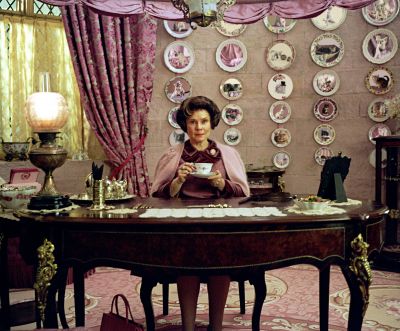

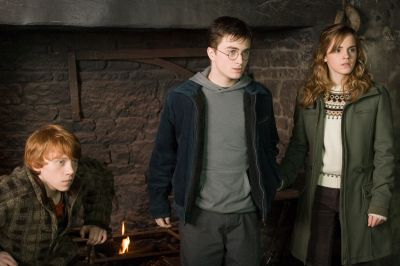
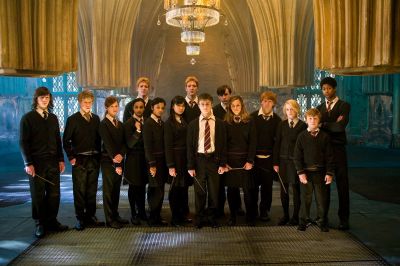
The first publicity stills from Warner Bros.'s 2007 adaptation of Harry Potter and the Order of the Phoenix have been released to Newsweek and various other media outlets and are now circulating the Web at a rapid rate; see, for example, www.hpana.com; www.mugglenet.com. Clearly the Harry Potter publicity machine is cranking into action. According to Mugglenet reporters who have visited the movie set at Leavesden Studios, UK, we are due a teaser trailer in November, ahead of the movie's release next July. Here are the photos made available by Warner Bros so far - the first of many no doubt!
As for the photos themselves - I'm not convinced that Umbridge looks sufficiently gruesome ... Umbridge, to my mind, is one of the most chilling and evil fictional baddies we have, and I hope this film ensures we get a strong sense of that - of course I have full faith in the acting powers of Imelda Staunton, who is one of our finest working actresses.
I absolutely love the shot of Harry pinioned to the floor in a grim, concrete underpass, adorned with graffitti - I presume this scene depicts Harry's self-defence against the dementors when they attack him and his chubby cousin Dudley at the start of the novel. I'm really hoping for some down and dirty, all-gritty realism in this picture; especially with David Yates at the helm, who is a tried and tested TV director of the highest calibre. This film needs to be angsty and dark in tone. And this time I want less of the Gothic hyperbole and more downright ugly Muggle-ness to express that.
Evanna Lynch as Luna Lovegood looks sweet enough in the movie still devoted to her - although she's also a spit for Tom Felton who plays bad boy Draco Malfoy in the movies ... didn't the producers realise this when she auditioned for the part?
Overall, not bad-looking so far. Am looking forward to more info and pics, although I somehow imagine they will soon be tough to avoid.
First pic of Kidman as Mrs Coulter online
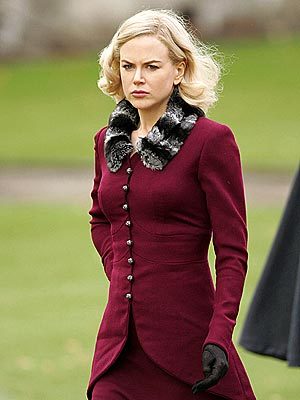
A photo of Nicole Kidman as Mrs Coulter, the villainess star of the Hollywood version of Philip Pullmans's first novel from the His Dark Materials trilogy, re-titled The Golden Compass from the print title Northern Lights has emerged online. The $150m production has been in production since September 4th.
Kirsten Scott-Thomas joins cast of The Other Boleyn Girl
Kirsten Scott-thomas has joined the cast of The Other Boleyn Girl, an adaptation of Phillipa Gregory's best-selling novel focussing on Anne and Mary Boleyn' s romantic entanglements with Henry VIII, and is set to play their mother, Lady Boleyn. Spanish actress Ana Torrent has been attached to the project, according to IMDB (www.imdb.co.uk), as King Henry's first wife Katherine of Aragon. Natalie Portman is portraying the tragic, mercurial Anne Boleyn in this production with Scarlet Johansson taking on her sister Mary. Eric Bana plays Henry VIII and Jim Sturgess is George Boleyn.
Monday, September 25, 2006
Jane Eyre, BBC1 (Episode One) --- (REVIEW, JANE EYRE- 1/4, BBC1, 2006)
The new BBC adaptation of Jane Eyre, broadcast tonight, has been hotly anticipated, and strongly tipped by numerous magazine and newspaper articles here in the UK as this Autumn's red hot period romance. TV critics galore seem to be literally panting over the thought of Toby Stephens (Rochester) sporting a tousled, windswept wig and tight breeches whilst coming over all sultry with the latest 'plain Jane' Eyre - who, as it turns out, is never quite so plain as we're led to believe. This adaptation is definitely keen to sell the sexual attraction between the central romantic duo. Indeed, Jane's abuse-ridden childhood is fairly charged through at a fine gallop to ensure we get an adult Jane to Thornfield Hall and her first melodramatic encounter with a disgruntled Rochester on a chill, foggy day, as soon as is narratologically feasible, without completely confusing the poor viewer.
For all this, I couldn't help thinking that the much-truncated Lowood school sequences were still potentially confusing for a Jane Eyre 'novice' - we barely meet poor long-suffering Helen Burns, which somewhat diminishes the impact of her sad, untimely demise. Disappointing too are the opening scenes with young Jane languishing in a fantastical desert (supposedly symbolising her isolation) and again when she is banished to the Red Room, a terrifying experience in the novel and brilliantly enlivened in the 1996 Zeferelli filmic adaptation, with a junior Jane captured superbly by a soulful Anna Paquin.
This version's junior Jane is none other than Georgie Henley - little Lucy from last year's blockbuster The Lion, The Witch and The Wardrobe. One gets the feeling that Georgie was signed on first by the producers, and Ruth Wilson (older Jane) was partly chosen because of her strong physical resemblance to the child - although Wilson has many other glowing attributes to recommend her too, with a strong performance and subtly expressive demeanour. She is an improvement on Georgie, who is too round-eyed and jolly - and possibly a little too young as well.
There are two decent scenes from this version of Jane's otherwise disappointing 'childhood' sequences, which warrant mention. First there is a small moment when the loathsome Reed family are seated en tableau, dolled up to the nines, awaiting their family portrait, completely ignoring wee Jane, sat alone on the window seat. More affecting still is the famous moment when Jane is forced to stand alone on a stool at Lowood, branded a liar in front of her schoolmates by the heinous Mr Brocklehurst. The director Susanna White has recreated this scene with real pathos.
Thornfield is represented by a suitably splendid Haddon Hall (Derbyshire). Mrs Fairfax (Lorraine Ashbourne) is too cheery for my liking. Far better the slightly harrassed demeanour of Gemma Jones in the 1997 ITV version. Adele seems too old for her part, and indeed, the only half-decent Adele I have ever seen in a Jane Eyre adaptation is Josephine Serre in the 1996 film version.
But, most importantly, does Toby Stephens truly cut a swaggering enough dash in his breeches as moody Rochester? He is a handsome sod, that's for sure. And certainly his arrival does breathe fresh life into this production. His attraction to Jane is fairly obvious here, and it is interesting that we are certainly set to see more of the cut and thrust of their verbal exchanges than is common in contemporary TV romance. This is one of the best-loved 'meeting of minds' in romantic fiction, and this adaptation is set fair to relay this to us.
Even so, there is a slight sense of staleness in this particular couple's repartee ... a feeling that this is too well-worn, too well-known ... we've been here before, and the actors seem to know this too. It's obviously hard to inject freshness and vitality into a pairing which has become so iconic and beloved by audiences and readers the world over. Worse still, there is a slightly trite moment (which is taken straight from the novel) when Rochester studies Jane's dark, surreal sketches with intense interest ... and it is all too clear (and cliched) that the dark, broody man recognises his soulmate. How can an adapter make this moment fresh for a modern audience, when this is the source material for a 1001 formula romances - even though this is the original, the real McCoy? It's a tough ask. But perhaps a little more adventurous spirit, a will to approach the material with renewed vigour, was needed at this juncture.
Cinematographically there is much to recommend here. Colours are lush, suitably sombre-toned and Gothic, editing is fast-paced. There is a rather unsubtle motif in play - a red scarf occasionally wafting in the breeze from a window in the North Tower, where all of us who have read the novel know, lurks poor mad Bertha. It is a neat signification device but a little too obvious - red signifying danger and of course fiery passion, the tumultuous sexual journey which led to Bertha's eventual incarceration, and of course, a foreshadowing of her final inflammatory demise.
Overall this is highly watchable, if a little unoriginal in scope and treatment. Maybe it fares poorly in contrast to the BBC's triumphant Bleak House, broadcast in Autumn 2005. I am surprised that some previewers in the press were hailing this production as a continuation of that particular vein of excellent form, when in truth - based on this first episode - this adaptation falls short, even if both productions share the same director - although notably Susanna White shared direction responsibilities with Justin Chadwick during Bleak House.
Perhaps this is one Jane Eyre too many - albeit enjoyable for comparison purposes, and of course, it's a cracking yarn. But there is a sense here that no fresh approaches, new angles on such a well-told tale are being explored here, which is a shame ... of course, there are three more episodes to persuade me otherwise. But on first impressions, I must surprise myself with a continued preference for the 1996 Zeferelli film version, starring a growling, morose William Hurt as Rochester and a forlorn, sad-eyed Charlotte Gainsbourgh as Jane. The 1997 ITV version also stars a fine Jane in the form of Samantha Morton, but is badly let down by an over-the-top performance from Ciaran Hinds as Rochester, who bellows and rants throughout, while decked out in a devastatingly unattractive bushy black moustache which quivers and quakes on his top lip like a startled animal.
See Reviews of Jane Eyre, Episodes 2 and 3 and 4. Also Wide Sargasso Sea.
For all this, I couldn't help thinking that the much-truncated Lowood school sequences were still potentially confusing for a Jane Eyre 'novice' - we barely meet poor long-suffering Helen Burns, which somewhat diminishes the impact of her sad, untimely demise. Disappointing too are the opening scenes with young Jane languishing in a fantastical desert (supposedly symbolising her isolation) and again when she is banished to the Red Room, a terrifying experience in the novel and brilliantly enlivened in the 1996 Zeferelli filmic adaptation, with a junior Jane captured superbly by a soulful Anna Paquin.
This version's junior Jane is none other than Georgie Henley - little Lucy from last year's blockbuster The Lion, The Witch and The Wardrobe. One gets the feeling that Georgie was signed on first by the producers, and Ruth Wilson (older Jane) was partly chosen because of her strong physical resemblance to the child - although Wilson has many other glowing attributes to recommend her too, with a strong performance and subtly expressive demeanour. She is an improvement on Georgie, who is too round-eyed and jolly - and possibly a little too young as well.
There are two decent scenes from this version of Jane's otherwise disappointing 'childhood' sequences, which warrant mention. First there is a small moment when the loathsome Reed family are seated en tableau, dolled up to the nines, awaiting their family portrait, completely ignoring wee Jane, sat alone on the window seat. More affecting still is the famous moment when Jane is forced to stand alone on a stool at Lowood, branded a liar in front of her schoolmates by the heinous Mr Brocklehurst. The director Susanna White has recreated this scene with real pathos.
Thornfield is represented by a suitably splendid Haddon Hall (Derbyshire). Mrs Fairfax (Lorraine Ashbourne) is too cheery for my liking. Far better the slightly harrassed demeanour of Gemma Jones in the 1997 ITV version. Adele seems too old for her part, and indeed, the only half-decent Adele I have ever seen in a Jane Eyre adaptation is Josephine Serre in the 1996 film version.
But, most importantly, does Toby Stephens truly cut a swaggering enough dash in his breeches as moody Rochester? He is a handsome sod, that's for sure. And certainly his arrival does breathe fresh life into this production. His attraction to Jane is fairly obvious here, and it is interesting that we are certainly set to see more of the cut and thrust of their verbal exchanges than is common in contemporary TV romance. This is one of the best-loved 'meeting of minds' in romantic fiction, and this adaptation is set fair to relay this to us.
Even so, there is a slight sense of staleness in this particular couple's repartee ... a feeling that this is too well-worn, too well-known ... we've been here before, and the actors seem to know this too. It's obviously hard to inject freshness and vitality into a pairing which has become so iconic and beloved by audiences and readers the world over. Worse still, there is a slightly trite moment (which is taken straight from the novel) when Rochester studies Jane's dark, surreal sketches with intense interest ... and it is all too clear (and cliched) that the dark, broody man recognises his soulmate. How can an adapter make this moment fresh for a modern audience, when this is the source material for a 1001 formula romances - even though this is the original, the real McCoy? It's a tough ask. But perhaps a little more adventurous spirit, a will to approach the material with renewed vigour, was needed at this juncture.
Cinematographically there is much to recommend here. Colours are lush, suitably sombre-toned and Gothic, editing is fast-paced. There is a rather unsubtle motif in play - a red scarf occasionally wafting in the breeze from a window in the North Tower, where all of us who have read the novel know, lurks poor mad Bertha. It is a neat signification device but a little too obvious - red signifying danger and of course fiery passion, the tumultuous sexual journey which led to Bertha's eventual incarceration, and of course, a foreshadowing of her final inflammatory demise.
Overall this is highly watchable, if a little unoriginal in scope and treatment. Maybe it fares poorly in contrast to the BBC's triumphant Bleak House, broadcast in Autumn 2005. I am surprised that some previewers in the press were hailing this production as a continuation of that particular vein of excellent form, when in truth - based on this first episode - this adaptation falls short, even if both productions share the same director - although notably Susanna White shared direction responsibilities with Justin Chadwick during Bleak House.
Perhaps this is one Jane Eyre too many - albeit enjoyable for comparison purposes, and of course, it's a cracking yarn. But there is a sense here that no fresh approaches, new angles on such a well-told tale are being explored here, which is a shame ... of course, there are three more episodes to persuade me otherwise. But on first impressions, I must surprise myself with a continued preference for the 1996 Zeferelli film version, starring a growling, morose William Hurt as Rochester and a forlorn, sad-eyed Charlotte Gainsbourgh as Jane. The 1997 ITV version also stars a fine Jane in the form of Samantha Morton, but is badly let down by an over-the-top performance from Ciaran Hinds as Rochester, who bellows and rants throughout, while decked out in a devastatingly unattractive bushy black moustache which quivers and quakes on his top lip like a startled animal.
See Reviews of Jane Eyre, Episodes 2 and 3 and 4. Also Wide Sargasso Sea.
Tuesday, September 19, 2006
Robin Hood web site; Jane Eyre launch date
The BBC has launched a web site for its upcoming 13-part adventures series Robin Hood - see: http://www.bbc.co.uk/drama/robinhood.
The BBC has also launched a web site for its 4-part period drama Jane Eyre which is due to commence on Sunday 24th September, BBC One at 9.00pm. See: http://www.bbc.co.uk/drama/janeeyre.
ITV 3 has re-run the 1997 version of Jane Eyre (19th September) which starred Samantha Morton as Jane and Ciaran Hinds as Rochester.
A review of the latest version will follow soon after Episode One is aired.
The BBC has also launched a web site for its 4-part period drama Jane Eyre which is due to commence on Sunday 24th September, BBC One at 9.00pm. See: http://www.bbc.co.uk/drama/janeeyre.
ITV 3 has re-run the 1997 version of Jane Eyre (19th September) which starred Samantha Morton as Jane and Ciaran Hinds as Rochester.
A review of the latest version will follow soon after Episode One is aired.
Sky One seals deal for Pratchett adaptation?
Rumour has it that Sky One is set to sign veteran British TV actor David Jason to star in a new Terry Pratchett adaptation. Joss Ackland is also set to star. More details as they emerge ...
Monday, September 18, 2006
More cast speculation for Persuasion 2007
According to both Austenblog (www.austenblog.com) and the listing for the 2007 ITV version of Persuasion on Internet Movie Database (www.imdb.com), new cast members have been added. These are:
Marion Bailey - Mrs Croft
Peter Wight - Admiral Croft
Alice Krige - Lady Russell
Tobias Menzie - William Elliot
Joseph Mawle - Harville
Finlay Robertson - James Benwick
Mary Stockley - Mrs Clay
Sam Hezeldine - Charles Musgrove
It appears that Julia Davis has been confirmed as Anne Elliot's sister Elizabeth, but no news yet on her younger sister Mary, Charles Musgrave's wife. Neither is there information as yet on the remaining Musgrove family - Mr and Mrs Musgrove and their daughters Henrietta (and her cousin/lover Charles Hayter) and Louisa. Other missing castings include Lady Dalrymple and Miss Carteret, Mrs Smith and Nurse Rooke.
Marion Bailey - Mrs Croft
Peter Wight - Admiral Croft
Alice Krige - Lady Russell
Tobias Menzie - William Elliot
Joseph Mawle - Harville
Finlay Robertson - James Benwick
Mary Stockley - Mrs Clay
Sam Hezeldine - Charles Musgrove
It appears that Julia Davis has been confirmed as Anne Elliot's sister Elizabeth, but no news yet on her younger sister Mary, Charles Musgrave's wife. Neither is there information as yet on the remaining Musgrove family - Mr and Mrs Musgrove and their daughters Henrietta (and her cousin/lover Charles Hayter) and Louisa. Other missing castings include Lady Dalrymple and Miss Carteret, Mrs Smith and Nurse Rooke.
Friday, September 15, 2006
Casting update for Northanger Abbey 2007
Austenblog (www.austenblog.com) reports that the role of Frederick Tilney is to be played by Mark Dymond in ITV's 2007 production of Northanger Abbey.
Subscribe to:
Posts (Atom)